
What Is a Color Sorter Machine and How Does It Work?

When grains, seeds, or other agricultural products are processed, not every piece will have the same quality. Some may be discoloured, damaged, immature, stained, or contaminated with unwanted materials.
Traditionally, removing these defects could require manual inspection and sorting. A color sorter machine provides a faster and more consistent way to identify and separate unwanted material from a larger stream of products.
But how does a machine actually know which grain is good and which one should be rejected?
A color sorter combines cameras, image-processing technology, and precisely controlled air jets to inspect individual pieces of material and separate those that do not meet the selected quality criteria.
What Is a Color Sorter Machine?
A color sorter machine is an automated sorting system that uses optical technology to identify differences in the appearance of individual products and separate them according to their programmed sorting requirements.
Depending on the application, color sorters can be used to process products such as:
- Rice
- Wheat
- Maize
- Beans and other pulses
- Seeds
- Nuts
- Other agricultural products and processed materials
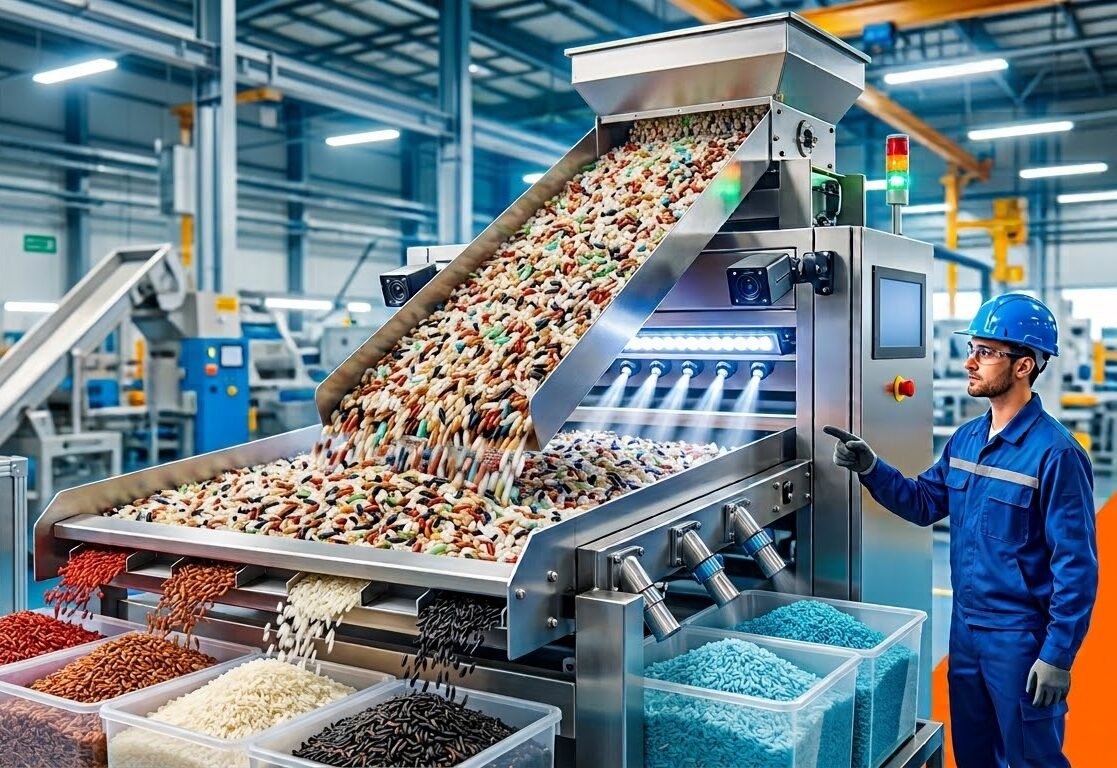
The machine examines the product as it passes through the sorting chamber. Its cameras detect differences in characteristics such as color, brightness, and appearance. When a piece is identified as unwanted, the machine activates an air-jet system to remove it from the main product stream.
The result of this is a cleaner and more uniform final product.
Why Is Color Sorting Important?
Agricultural products can naturally contain variations after harvesting, drying, storage, and processing.
For example, a batch of rice may contain discoloured grains, yellow grains, blackened grains, or other unwanted particles. Even when the majority of the batch is acceptable, these defects can affect the appearance and overall quality of the finished product.
This is particularly important when products are being prepared for commercial sale.
A cleaner and more uniform product can improve its appearance, help maintain consistent quality, and reduce the amount of defective material reaching the final packaging stage.
Instead of relying entirely on workers to identify every defective piece, a color sorter can inspect large quantities continuously and make sorting decisions at high speed.
How Does a Color Sorter Machine Work?
Although different machines may have different configurations and features, the basic sorting process follows a similar sequence.
1. Material Enters the Machine
The process begins when the product is loaded into the machine’s hopper.
From there, the material is directed into the sorting system and distributed into controlled streams. The machine is designed to present individual grains, seeds, or other pieces in a way that allows the optical sensors to inspect them.
The more consistently the material flows through the inspection area, the more effectively the machine can identify individual defects.
2. The Product Passes Through the Inspection Area
The material then moves past the machine’s cameras and optical sensors.
This is where the machine examines the appearance of individual pieces.
Depending on the machine, the optical system may detect differences in color, brightness, shape, or other visual characteristics. Some advanced systems can also use additional imaging technologies to identify defects that may not be obvious to the human eye.
The machine processes these images extremely quickly as the material moves through the sorting channel.
3. The System Identifies Defective Material
The sorting system compares what the cameras see against the sorting criteria programmed into the machine.
For example, if a rice-processing operation wants to remove discoloured grains, the system can be configured to recognize the unwanted color characteristics.
When the machine identifies a piece that falls outside the acceptable range, it determines that the material should be rejected.
This is where the machine’s image-processing and sorting technology becomes important.
4. Air Jets Remove the Rejected Material
Once a defective piece has been identified, the machine has only a very short amount of time to remove it.
The colour sorter’s precisely positioned air nozzles are used to eject the unwanted material from the main product stream.
It’s system activates the appropriate air jet at the right moment, creating a short burst of compressed air that changes the trajectory of the rejected piece.
The acceptable material continues along its normal path, while the rejected material is directed into a separate collection area.
5. Clean Product and Rejects Are Separated
At the end of the process, the material is divided into different outputs.
The accepted product continues toward the clean-product outlet, while rejected material is collected separately.
This continuous process allows the machine to inspect and sort large quantities without requiring every individual piece to be manually examined.
Where Does AI Come Into Color Sorting?
Modern color sorters can use advanced image-processing and artificial intelligence technologies to improve their ability to recognize different types of defects.
So instead of simply asking whether an object is one color or another, advanced sorting systems can analyze visual characteristics and distinguish between acceptable and unacceptable material based on programmed sorting criteria.
This can be particularly useful when defects are subtle or when a processor needs more precise control over the quality of the final product.
However, the exact technology used varies between machines and manufacturers. Some systems rely primarily on optical cameras and programmed color thresholds, while more advanced models may incorporate AI-based algorithms and additional imaging technologies.
What Can a Color Sorter Detect?
The exact defects a machine can identify depend on the model, sensors, software, and material being processed.
Common examples can include:
- Discoloured grains
- Black or dark grains
- Yellow or stained grains
- Damaged or defective pieces
- Foreign materials with different visual characteristics
- Other unwanted particles that can be visually distinguished from the acceptable product
The sorting capabilities of the machine you choose, should therefore be evaluated based on the specific crop or material you intend to process.
Color Sorter vs Manual Sorting
Manual sorting requires workers to inspect products and remove unwanted material by hand.
This can work for smaller quantities, but it becomes increasingly difficult to maintain the same speed and consistency as your business’s processing volumes increase.
A color sorter automates this inspection and rejection process.
This can provide several advantages:
Higher sorting speed
More consistent sorting
Reduced dependence on manual inspection
Improved product appearance
Is a Color Sorter Suitable for Every Business?
Not necessarily.
The right sorting equipment depends on factors such as:
- The type of material being processed
- The volume that needs to be sorted
- The types of defects that need to be removed
- Required sorting accuracy
- Available power supply
- Available operating space
- Budget
- The rest of the processing line
For a small operation, the requirements may be very different from those of a large commercial processing facility.
Before purchasing a color sorter, it is important to understand what you need the machine to achieve rather than choosing a machine based only on its advertised capacity or pricing.
Final Thoughts
What makes the technology valuable is the speed and consistency with which this process can be carried out.
For processors handling grains, seeds, and other agricultural products, understanding how color sorting works is an important first step before deciding whether the technology is suitable for their operation.
If you are considering a color sorter, the next step is to look beyond the basic definition and understand the machine’s capacity, sorting channels, detection technology, and the specific defects it can remove.
Explore More About Color Sorting
- 5 Things a Color Sorter Can Detect
- How Color Sorters Improve Rice Quality and Reduce Defective Grains
- Home
2 comments on “What Is a Color Sorter Machine and How Does It Work?”