
What Is an Industrial Flour Mill and How Does It Work?

An industrial flour mill is a machine designed to grind grains and other suitable dry materials into flour, meal, or other finely processed products at a larger scale than conventional household or small commercial grinders. Industrial flour mills are used by food processors, agro-processing businesses, commercial flour producers, animal feed manufacturers, and other businesses that need consistent processing and higher production capacity.
However, not every flour mill works in the same way. Different machines use different milling mechanisms, offer different levels of fineness, and are designed for different materials and production requirements.
Understanding how an industrial flour mill works can help you determine what type of milling equipment is appropriate for your operation.
What Is an Industrial Flour Mill?
An industrial flour mill is a piece of processing equipment used to reduce grains or other compatible dry materials into smaller particles through a controlled milling or grinding process.
Depending on the machine, the process may involve impact grinding, rollers, screens, or other mechanical components. The finished product can range from a relatively coarse meal to a fine powder, depending on the machine and the required specification.
Industrial flour mills are designed for applications where manual or small-scale grinding would not provide the required production volume, consistency, or operating efficiency.
Common materials processed by industrial milling equipment can include wheat, corn or maize, sorghum, rice, millet, dried cassava, and other suitable dry materials. Some machines are also designed to process materials such as dry spices, dried vegetables, or feed ingredients.
The important point is that material compatibility depends on the specific machine. A flour mill designed primarily for wheat, for example, may have different operating characteristics from a multi-grain grinding machine.
How Does an Industrial Flour Mill Work?
Although milling systems differ, the basic process follows several stages.
1. Grain Preparation
Before material enters the mill, it needs to be prepared appropriately for processing.
This can include removing stones, metal, dirt, and other foreign materials. The material may also need to be dried or brought to a suitable condition for the particular milling process.
Feed preparation is important because the condition and size of the material entering the machine can affect the milling process and final output.
2. Feeding the Material
Prepared material is introduced into the machine through the feeding system.
The feed rate needs to be appropriate for the machine’s operating capacity. Feeding too aggressively can place unnecessary load on the grinding system, while inconsistent feeding can affect production.
3. Grinding or Milling
The exact mechanism depends on the type of flour mill. In an impact mill, material is broken down through high-speed mechanical impact inside the grinding chamber. In a roller mill, material passes between rollers that reduce its size through compression and related milling forces.
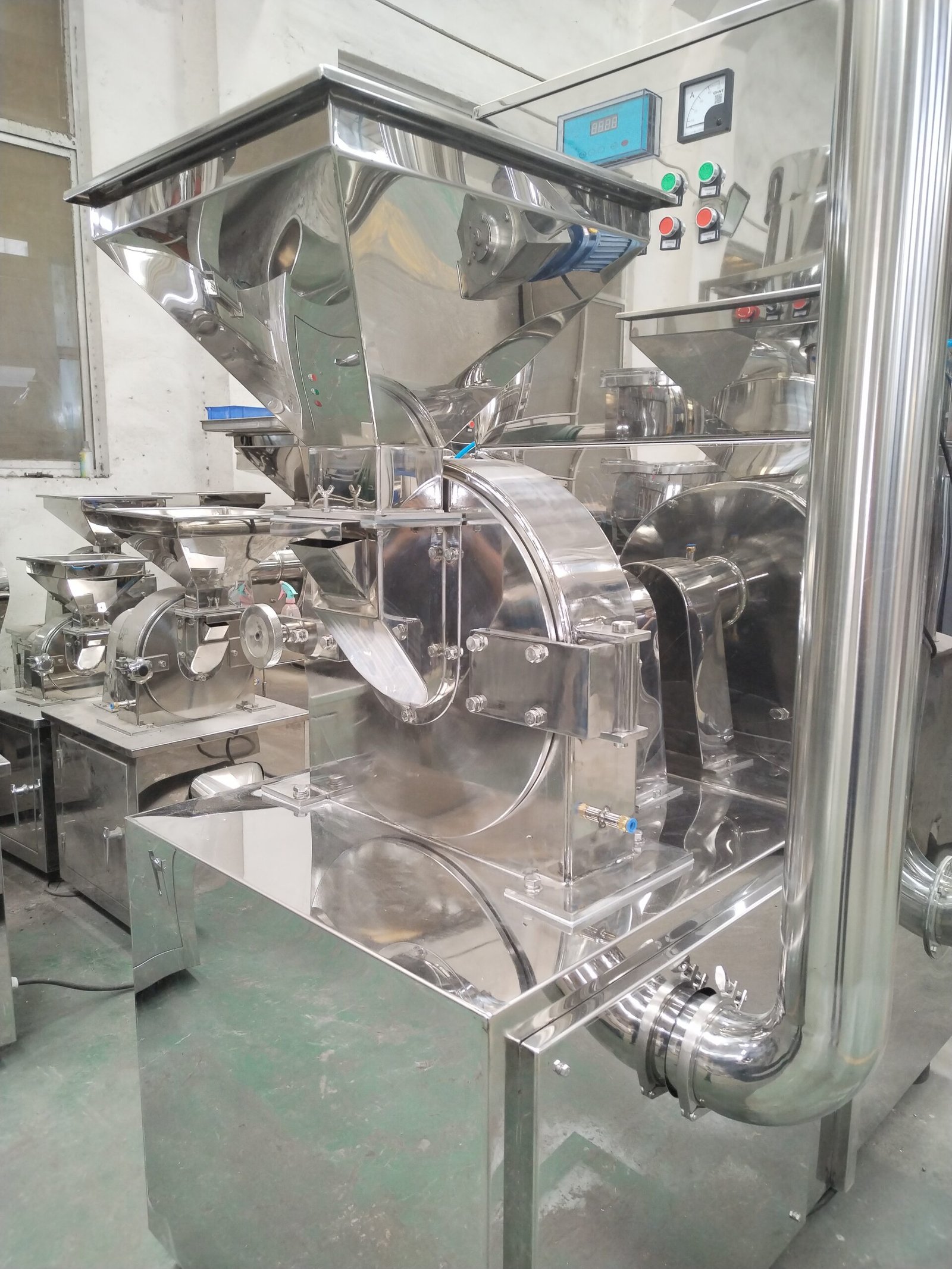
For example, the Model 40B Industrial Flour Mill uses a high-speed impact milling system operating at 3,400 RPM. It is designed for high-capacity processing of various dry grains and other compatible materials.
The Model 2250 Industrial Roller Flour Mill, on the other hand, uses a roller-based milling system and is primarily designed for wheat flour production.
This difference is important because the term “industrial flour mill” describes a category of equipment rather than one specific milling mechanism.
4. Controlling Fineness
The desired particle size is another important part of the milling process.
Some machines use screens or sieves to control the size of the material leaving the grinding chamber. Depending on the machine and its configuration, different settings can produce different levels of fineness.
For instance, the Model 40B offers an adjustable fineness range of approximately 20 to 120 mesh. This allows the machine to be configured for different processing requirements within its intended applications.
Other machines may have a more specific or fixed milling configuration. The appropriate fineness therefore depends on both the product being made and the machine being used.
5. Collecting the Finished Product
After milling, the processed material needs to be discharged and collected.
Industrial systems may use discharge outlets, collection equipment, cyclones, filters, or dust-collection systems depending on the machine design.
Proper collection is particularly important in flour milling because fine particles can become airborne during processing. Some industrial flour mills therefore incorporate dust-collection equipment as part of the milling system.
What Are the Main Components of an Industrial Flour Mill?
The exact components vary between machine designs, but an industrial flour mill may include:
Feeding system: Introduces grain or other material into the milling chamber at a controlled rate.
Grinding or milling mechanism: Performs the main size-reduction process. This may involve impact grinding, rollers, or another mechanical system.
Grinding chamber: The area where material undergoes the primary milling process in machines that use an enclosed grinding system.
Screens or sieves: Help control the particle size of the material leaving the machine where the design uses screening.
Motor and drive system: Provides the mechanical power required for milling.
Discharge and collection system: Moves processed material out of the machine and into an appropriate collection point.
Dust-collection system: Captures airborne dust and fine particles in machines equipped with this feature.
The combination of these components determines how the machine operates and what type of material and production requirements it can handle.
Do All Industrial Flour Mills Work the Same Way?
No they don’t. This is one of the most important things to understand when evaluating milling equipment for your needs.
BrandSquare’s flour-milling equipment illustrates this difference.
BB-F180Z Fine Powder Flour Grinder
Its design and capacity are different from larger industrial systems, making it important to consider the required production volume before selecting a machine.
Model 40B Industrial Flour Mill
The Model 40B Industrial Flour Mill is a high-capacity impact mill designed for continuous commercial-scale grinding.
It has a stated capacity of approximately 400–800 kg per hour and offers adjustable fineness from about 20 to 120 mesh. It can process a wider range of suitable dry materials, including wheat, corn, sorghum, rice, dried cassava, millet, and certain dry spices and feed ingredients.
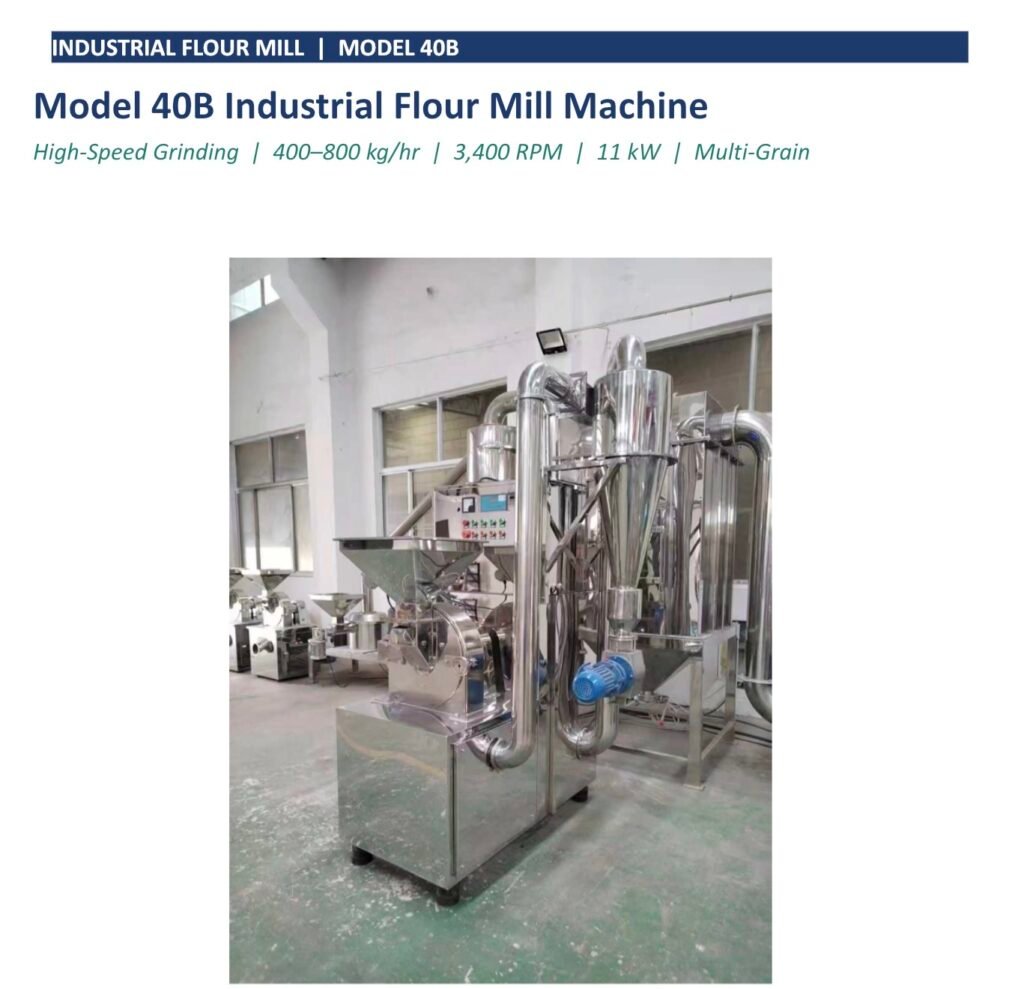
Its high-speed grinding system and integrated dust collector make it suited to larger-scale processing applications.
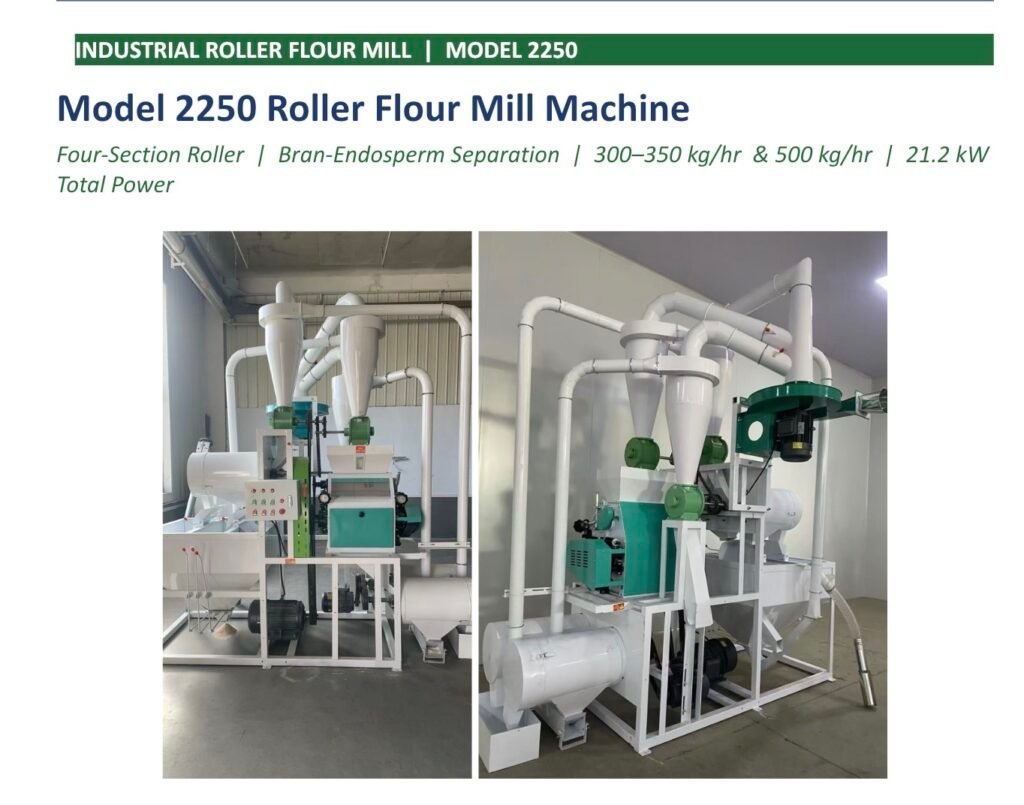
Model 2250 Industrial Roller Flour Mill
The Model 2250 Industrial Roller Flour Mill uses a different approach.
It is a roller milling machine designed primarily for wheat and is suited to applications where roller milling and refined wheat flour production are required.
This means that choosing between different flour mills should not be based on capacity alone. The milling mechanism, material, desired product, and operating requirements all matter.
What Affects the Output of an Industrial Flour Mill?
A machine’s stated capacity is useful, but actual output can vary depending on operating conditions.
Several factors can influence production:
Type of Material
Different grains and materials have different physical characteristics. Wheat, corn, sorghum, rice, and other materials may behave differently during milling.
Feed Size
The size of material entering the machine can affect how efficiently the milling system processes it. Some industrial mills specify a maximum feed particle size.
Material Condition
Desired Fineness
Producing a finer powder generally requires different milling conditions from producing a coarser meal. The selected screen, sieve, roller configuration, or other adjustment can affect throughput.
Machine Capacity and Operating Conditions
A machine’s rated capacity provides a useful reference, but actual production depends on the material being processed, desired fineness, feed conditions, and other operating factors.
For this reason, comparing machines only by their maximum kilograms-per-hour figure can lead to the wrong purchasing decision.
Where Are Industrial Flour Mills Used?
Industrial milling equipment can be used across several processing industries, depending on the machine’s capabilities.
Applications can include:
- Commercial flour production
- Agro-processing businesses
- Food processing
- Industrial bakeries and food manufacturers
- Animal feed production
- Grain grinding services
- Processing of suitable dried spices and other agricultural materials
How Do You Choose the Right Industrial Flour Mill?
Before purchasing an industrial flour mill, consider more than the machine’s advertised capacity.
Start with the material you intend to process. Confirm that the machine is designed to handle it.
Next, consider your required production volume. A small operation may not need the same capacity as a commercial processing facility.
You should also determine the fineness required for your finished product. Different machines and configurations offer different levels of particle-size control.
Other important considerations include:
- Milling mechanism
- Power requirements
- Feed size requirements
- Installation space
- Dust collection
- Maintenance requirements
- Availability of suitable electrical supply
- The type of final product you intend to produce
Taking these factors together gives you a much better basis for choosing milling equipment than looking at capacity or price alone.
Final Thoughts
An industrial flour mill is more than a machine that simply turns grain into flour. It is a processing system whose design, milling mechanism, capacity, fineness control, and operating requirements determine how suitable it is for a particular production application.
From compact fine-powder grinders such as the BB-F180Z to high-capacity impact mills such as the Model 40B and roller-based systems such as the Model 2250, different machines are designed to solve different milling requirements.
If you are planning to invest in flour milling equipment, the most important step is to understand your material, production requirements, desired fineness, and operating environment before choosing a machine.
Looking for the right flour milling equipment for your operation? Contact BrandSquare to discuss your processing requirements and explore the available machine options.
Continue Learning
- 7 Things to Check Before Buying an Industrial Flour Mill
- Why Dust Collection Matters in Industrial Flour Milling
1 comment on “What Is an Industrial Flour Mill and How Does It Work?”