

The True Cost of Broken Rice: How Sieve Meshes and 3-Way Sorting Protect Sack Pricing
In the commercial grain processing business, profitability depends directly on grain integrity. When wholesale buyers inspect a 50 kg bag of white rice, they check both color and the percentage of cracked or broken kernels.
Understanding the true cost of broken rice is essential for commercial millers. When whole grains crack during milling, their commercial value drops significantly. Instead of commanding peak market rates as premium head rice, fractured grains are heavily discounted or sold off for flour milling and animal feeds.
When broken grains remain mixed with whole grains, the entire sack is valued at the lower grade, reducing the processor’s profit margin.
Protecting your wholesale sack pricing requires controlling friction inside the milling chamber with the right sieve meshes and mechanically grading the output through automated multi-stage sorting.
1. What Broken Grains Cost Your Mill
Whole white rice commands the highest commercial value in retail and wholesale markets. Broken grains sell at a steep discount, often losing 30% to 50% of the price of whole grains depending on regional demand.
| Output Grade | Market Classification | Typical Pricing Impact |
| Whole Grain (Head Rice) | Premium table rice | Full baseline wholesale price |
| Medium Broken Rice | Secondary household use | 25% – 35% discount below whole grain |
| Small Broken Fragments | Brewing adjuncts, rice flour, animal feed | 50%+ discount below whole grain |
If a processing plant handles 4,000 kg of paddy per day, an uncalibrated milling setup that yields 25% broken rice instead of an industry standard of 10% loses significant revenue daily. Over a standard harvest season, those compounding losses can equal the cost of an entirely new commercial milling unit.
2. Preventing Breakage: Selecting the Correct Sieve Mesh
Grain breakage is usually caused by excessive chamber friction, incorrect spindle speeds, or using the wrong sieve mesh.
In commercial setups like BrandSquare’s 5-in-1 Commercial Rice Mill (Model BB-N70-21), the milling spindle operates at 2,200 RPM. At this speed, the sieve mesh must be matched to the specific paddy variety to balance husk removal and grain protection:
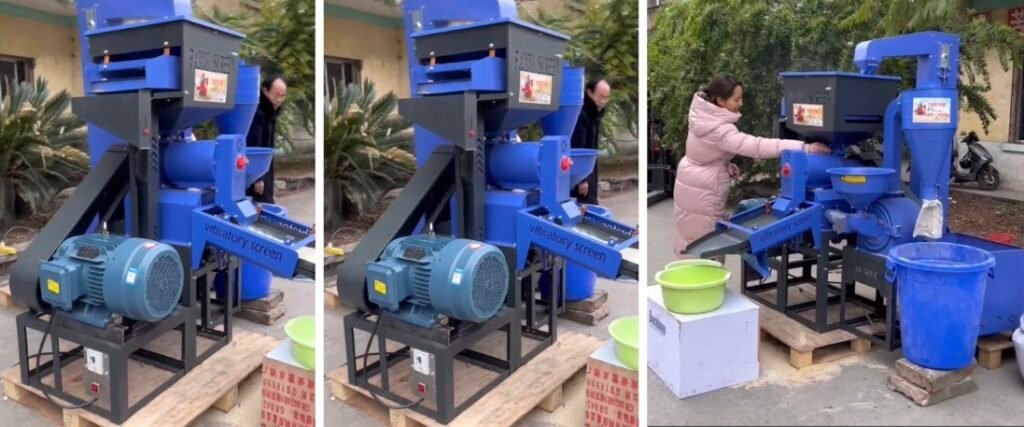
5-in-1 Commercial Rice Mill (Model BB-N70-21)
- 1.3 mm Sieve Mesh: Best suited for long-grain varieties with hard, durable structures. It allows smooth flow and clean husk stripping without generating excessive pressure in the chamber.
- 1.0 mm Sieve Mesh: The standard configuration for medium-grain local paddy varieties, providing consistent whitening while minimizing stress on the kernel.
- 0.7 mm Sieve Mesh: Designed for shorter or more brittle paddy varieties, where tighter tolerances prevent grains from snapping under rotational friction.
Matching your sieve screen to the physical density and moisture profile of the grain strips the outer bran layer in a single pass without crushing whole kernels.
3. How 3-Way Sorting Protects Sack Pricing
Even with calibrated sieve screens, mechanical stress causes some grains to fracture during hulling and whitening. The common mistake in traditional mills is allowing whole grains and broken fragments to exit through the same chute into the same collection bag.
When mixed together, buyers price the entire bag based on the broken fragments. Modern 5-in-1 rice mills solve this problem using an integrated broken rice separator with three dedicated outlets:
- Outlet 1 (Whole Grain Head Rice): Delivers clean, intact whole rice that meets commercial packaging standards and commands top market pricing.
- Outlet 2 (Medium Broken Rice): Discharges medium cracked grains separately, allowing you to bag and sell them for family meal use at a fair secondary price.
- Outlet 3 (Fine Broken Fragments): Directs small rice chips into an independent bin for sale to flour producers, breweries, or animal feed compounders.
On models like the BB-NF2024-21R PRO MAX, the separator operates at a high-frequency vibration of 637 beats per minute, achieving a broken rice separation rate of at least 95%. This mechanical sorting ensures that whole grain sacks remain free of discount fragments.
The Takeaway
Protecting your processing business against broken rice requires mechanical control at every stage.
By using the correct sieve mesh size for your raw paddy and sorting output into distinct grades through 3-way discharge chutes, commercial millers eliminate the discount on mixed bags and maximize revenue across every kilogram processed.
Continue Reading:
- Monetizing Agricultural By-Products: Turning Husks, Bran & Press Cake into Feed
- Commercial Groundnut & Sesame Oil Production in Nigeria
- The Economics of Small-Scale Cold-Pressed Oil Production in Nigeria: Costs, Yields, and Margins
Looking to upgrade your processing line with integrated destoning, calibrated sieves, and automated broken rice separation? Review complete machinery specifications at BrandSquare.shop.
Join the BrandSquare WhatsApp Community
Get machine updates, buying tips and new arrivals straight to your phone.