
5 Costly Mistakes to Avoid When Operating an Industrial Powder Crusher
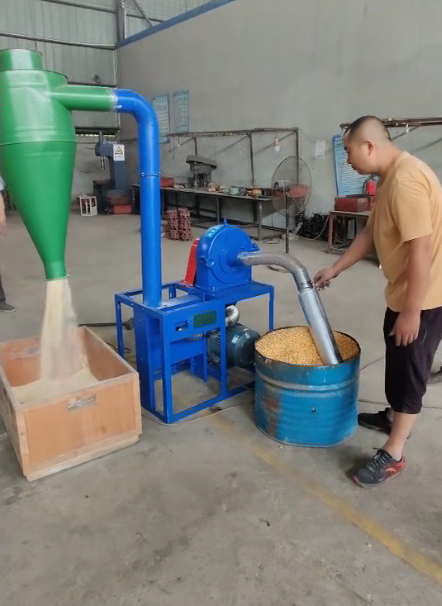
In commercial agro-processing and spice milling, throughput is revenue. When an operation relies on a high-speed machine like the 9FC-290 Automatic Powder Crusher, which spins its central shaft at 4,000 RPM to deliver up to 1,000 kg per hour, the downtime is expensive.
Operating at 4,000 RPM generates enormous kinetic energy. That velocity is what pulverizes dry maize, dried peppers, ginger, and herbs into fine meal in seconds. However, high speed leaves zero room for basic operational shortcuts.
If your operators make any of these five common mistakes, you risk blown circuit breakers, torn internal sieves, contaminated flour, and permanent motor burnout.
1. Feeding Wet, Damp, or Oily Raw Materials
The single fastest way to destroy production efficiency is introducing damp inputs. The 9FC-290 is an impact pulverizer engineered strictly for dry solid materials.
When damp corn kernels, semi-dried cassava chips, or oily seeds enter the grinding chamber, the pulverizing action turns the material into a dense, sticky paste. This paste immediately plasters over the internal screen openings.
- Once screen pores are blinded, crushed powder cannot exit the chamber smoothly.
- All raw materials must have their moisture reduced (ideally below 12%) before entering the hopper. If your tubers or grains feel slightly soft or cold to the touch, run them through an industrial chamber dryer, or sundry before milling.
2. Skipping the Feed Pre-Cleaning
The hardened steel hammers inside a powder crusher chamber will strike incoming material thousands of times per second. If a piece of gravel, a loose nut, or tramp metal enters the feed inlet, the impact is destructive.
Metal-on-metal impact at that velocity shatters grinding teeth, tears through the perforated classifier screen, and creates sparks that present a severe dust-explosion risk in dry milling rooms.
- Always inspect your raw stock. For continuous production lines, install a basic gravity sieve or rare-earth magnetic trap across the feed chute to catch ferrous debris before it reaches the grinding chamber.
3. Starting the Motor Under Load
Never turn on an industrial powder crusher while there is residual material sitting in the grinding chamber or hopper.
A standard 7.5 kW, 380V three-phase motor requires a clean, low-resistance spin to reach its operating velocity. Starting a machine packed with settled grain causes an immediate current spike. The motor strains against the packed mass, resulting in blown fuses, scorched contactor points, or motor winding failure.
- The Correct Startup Sequence:
- Inspect the chamber to ensure it is 100% empty.
- Turn on the motor and let it run unloaded for 15 to 30 seconds until it stabilizes at full speed (4,000 RPM).
- Listen for balanced, smooth rotation.
- Open the feed gate gradually to ramp throughput up to the rated capacity.
4. Ignoring Screen Wear and Operating With Tears
The internal sieve wrapped around the grinding zone controls your particle fineness. Particles can only exit into the discharge chute once they are broken down small enough to clear the screen apertures.
Because high-speed pulverizing is naturally abrasive, screens wear out. A cracked or torn screen allows oversized, unground flakes straight into the collection bin. For commercial spice or baking flour producers, out-of-spec particle sizes ruin batch consistency and lead to rejected consignments. Inspect the screen at the end of every working shift.
5. Abrupt Shutdowns Without Running the Chamber Empty
When close of work arrives or a power surge appears, untrained workers often hit the stop button while material is still dropping into the hopper.
Leaving hot, pulverized powder inside an unvented chamber allows residual moisture to settle into the crevices and cake onto the screen. Overnight, this residue hardens like cement, seizing the shaft for the next shift.
- Allow the machine to run for 30 to 45 seconds until the discharge chute stops outputting dust and runs completely clear. Only then should you power down the motor.
Summary Checklist for Machine Operators
| Inspection Point | Frequency | What to Check |
| Raw Material Moisture | Every batch | Dry, brittle inputs only (<12% moisture) |
| Magnetic Trap / Hopper | Hourly | Clear foreign gravel, metal chips, and debris |
| Internal Sieve / Screen | Daily | Check for tears, stretched holes, or paste buildup |
| Shaft Balance & Bearings | Weekly | Check lubrication and listen for high-frequency vibration |
| Air Vents & Motor Casing | Daily | Brush away powder accumulation to ensure air cooling |
Need the Right Powder Processing Setup for Your Facility?
Whether you need an entry-level 220V 9FC-210 (200–400 kg/hr) for specialty spices or the 7.5 kW 9FC-290 (1,000 kg/hr) for high-volume grain processing, Brandsquare supplies factory-direct units with matched screens and local delivery support across Nigeria.

Entry-level 220V 9FC-210 (200–400 kg/hr)

7.5 kW 9FC-290 (1,000 kg/hr)
- Explore Specifications & Pricing: Visit brandsquare.shop
- Get Sizing & Landed Cost Support: Speak directly with our specialist team to match your power setup and material requirements.
Join the BrandSquare WhatsApp Community
Get machine updates, buying tips and new arrivals straight to your phone.
1 comment on “5 Costly Mistakes to Avoid When Operating an Industrial Powder Crusher”